Monday, November 16, 2009

Recipe #15/20: Lentil Lasagna!

Semi-exciting news on the lentil diversity front! When I went to the co-op to pick up more lentils, (I was running low on green) I found......French green lentils! Also known as Puy lentils, they are a little smaller than traditional green lentils, but look way cooler. They are also supposed to have a richer flavor. Technically, these are not Puy lentils as they were grown in Canada and not one of the few regions in France that reserve the Puy lentil title according to the Appellation d’Origine Contrôlée, but they are the same botanical variety. Now I just need to get my hands on some black beluga lentils before this project is done.

As for the lasagna: sadly, the lentils compose only the sauce of the lasagna, not the noodles themselves. I would like to try to make lentil pasta as one of the remaining recipes, but this week I just do not have the time. For those of you who don't know, I am currently in the process of applying to graduate school for a Ph.D. in bioengineering. There are twelve schools I am applying to and as application deadlines are roaring closer, it is tough to make time for super-diverse applications. Perhaps this weekend I'll think of something. On a fun, related note though, I did talk about this project in my personal statement in my applications, comparing my interest in altering lentils into previously unexplored regions to the genetic manipulations conducted in the field of synthetic biology. So if nothing else, at least this project led to an interesting beginning to my application essay.

On to the lasagna! I found this recipe online after a friend suggested that I make lasagna. It is pretty easy and consists of three parts: lentil sauce, cheese sauce and assembly. I highly recommend making it in the order I have put them, rather than the cheese sauce before the lentil sauce as the recipe has because by the time the lentil sauce is ready, the cheese sauce would have become cold and clumpy. I also like baked recipes like this because while it is in the oven, you can do all of the other dishes so that when it is done, there is almost no clean up left! Also, I added Parmesan on top because every lasagna should have that. I mean seriously.

The taste is delicious. The lentils have a very meaty texture which compliments nicely with the softness of the noodles and creaminess of the cheese sauce. And with the weather storming outside last night and the temperatures dropping everywhere, the timing is perfect. The only complaint that I have is that I didn't give the lasagna box a little rattle before buying it and it wasn't until I got home that I realized most of the noodles were broken. Still just as tasty though.

Enjoy this recipe and hopefully by the end of this week I'll have a good number of applications out the door and will be able to start down the home stretch of the Great Lentil Adventure!

(Also, feel free to leave suggestions regarding the next ingredient to try. I'm curious to know what you think.)


Lentil Lasagna
Serves 6 to 8 people

Ingredients

1 12oz. box lasagna noodles
7 oz. (200g) cheese, grated (I used raw sharp chedder)
3 oz. (80g) AP flour
3 cups whole milk
1 oz. (2 Tbsp.) butter
1/4 tsp. freshly grated nutmeg
2 bay leaves
7 oz. (200g) green lentils
1 29 oz. can diced tomatoes (I used fire roasted for a little extra flavor)
2 onions
1/4 cup vegetable or olive oil
1 Anaheim pepper (though any mildly spicy, green pepper will do)
1 tsp each dried basil and oregano
Salt and black pepper
1/2 cup grated Parmesan cheese

Lentil sauce

Rinse the lentils and cook in two cups of water for 30 minutes. Finely chop onions and soften on in a large skillet in oil with a bay leaf on medium heat for ten minutes. Add the chopped pepper and cook for a further five minutes. Add the chopped tomatoes, cooked lentils, basil, oregano, and season with black pepper. Mix well and simmer gently for another five to ten minutes, stirring regularly.

Cheese sauce

Beat the flour in a small amount of the milk to a smooth, runny, paste in a small bowl. Warm the rest of the milk a little in a saucepan with the remaining bay leaf. Pour some of this warm, but not boiling, milk into the cold milk/flour mix, beating vigorously with a fork. (This is called tempering, in case you wanted to know.) Pour the warm flour/milk mix back into the saucepan containing the remaining warm milk, whisking constantly. Add the butter and bring slowly to a boil, again whisking. Stir the simmering mix for a few minutes, and take off the heat. Add salt and pepper to taste, the nutmeg, and the grated cheese, and stir well until the cheese melts.

Assembly

Butter an oven-proof dish. (I used a large Pyrex dish. I think it is around 17.5" x 11" x 2-3", but anything around that should do.) Spoon a shallow layer of lentil sauce across the bottom. Next, add a single layer of lasagna, covering the sauce. Then, add a layer of cheese sauce followed by another layer of lasagna. Repeat lentil, lasagna, cheese, lasagna until all but the cheese sauce is gone, then finish with the remaining cheese. Finally, cover with grated Parmesan cheese and bake in a 350F oven for 45 minute. Allow to rest at least five minutes before serving. Enjoy!


Tuesday, November 10, 2009

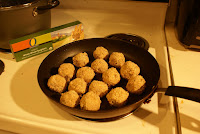
Recipe #14/20: Spaghetti and Lentil "Meatballs"!


So naturally, after realizing the cooked lentil cheese in the lentil pizza tasted like meatballs, I had to try spaghetti with lentil meatballs. I've never made meatballs before (hell, I think in the two plus years I've lived in Seattle, I've only made spaghetti once), so I searched around for a few
recipes in an effort to get a general idea of how most people make them. Essentially, it is just ground meat mixed with a few herbs and spices, then coated in egg and breadcrumbs and browned in oil. Fairly straightforward. I also searched for sauce recipes and found one that I could assemble in the same pan after the meatballs had browned, simmering them for the remaining cooking time. As for pasta, I chose a whole wheat pasta to round out the earthy flavors of the lentil cheese and sauce.

The meatballs are actually pretty tasty. They are very very lean, so they can be a little bit dry, but they have a nice flavor. I think next time I may mix a little fat in with the meatball mix to help keep them moist. The pasta sauce is quite good and is certainly one that I would use again next time I get around to making pasta. Additionally, the recipe didn't take too long and made enough for leftover lunches for almost the whole week. Other than the actual process of making the lentil cheese, it is a nice recipe for a quick, mid-week dinner. Enjoy!


Lentil Meatballs
Serves four to six

Ingredients

~1.5 lbs. lentil cheese (see lentil pizza post)
2 tsp Worcestershire sauce
3/4 cup Parmesan cheese
1/4 tsp garlic powder
3 Tsp dried parsley
1 egg or 1/2 cup egg nog
1/2 cup bread crumbs
1/2 cup olive oil
1 small onion
1 29 oz. can tomato sauce
1 6 oz. can tomato paste
1 cup stock (either beef or pork)
2 Tsp dried basil
1 Tsp anchovy paste (optional, but good)

1 lb. pasta, cooked

Combine the lentil cheese, Worcestershire sauce, 1/2 of the Parmesan cheese, garlic powder, and 1 Tsp dried parsley in a large bowl. (As I mentioned above, you could try adding perhaps 2 oz. butter, broken into little pieces, into the mixture in an effort to keep the meatballs more moist, though I have not tried this.) Mix with your hands to combine and form lentils into tight balls about the size of a golf ball. Heat the olive oil in a large skillet on medium-high heat. Dredge lentil balls in a beaten egg or egg nog, then in the bread crumbs and add to the skillet. Rotate each ball every 60-90 seconds until all sides have browned. Reduce heat to low and add remaining ingredients (except for the pasta). Stir gently to combine and let mingle for ~10 minutes. Serve atop pasta with some freshly grated Parmesan. Enjoy!


Monday, November 9, 2009

Recipe #13/20: Lentil Pizza! with.....Lentil "Cheese"!

Yeah! Lentil Pizza! To be specific, the crust is made of lentils. Well, that and the lentil cheese, but I digress.

A couple weeks ago, I was walking home from work and was struck with a sudden realization. Back during the epic night of eating at Sutra, which I had already mentioned was the inspiration for the delicious Chocolate Avocado cookies, we also had a spanakopita that contained pecan cheese. When I asked one of the waitresses, she explained that the cheese was actually made from fermenting the pecans and then separating them into curds and whey. I thought, could this work with lentils? Well, I found a recipe for Almond cheese and thought I would give it a try.

It turned out....interestingly. I sprouted a batch of lentils, but decided atleast for the first attempt not to remove all of the casings, like the recipes does with the almonds. Adding the water, I blended them with my stick blender and then covered them with cheese cloth to ferment for a day. After fermentation, they went in a stock sock and I drained them of the whey. The flavor is....well, bland. And since they have low fat content, they don't really perform like cheese (melting, etc.). But I thought I'd give it a try on the pizza, supplementing with other cheeses.

So now, the lentil pizza. Aside from the cheese, the only lentils that I used were red lentils to make the pizza base. It is quite tasty, but not really like a traditional pizza dough. Best eaten with a knife and fork, this pizza base has a nice, simple savory aspect provided you bench your assumptions about how pizza dough should taste. It is extremely simple, so next time you want to make a pizza give it a try. I used a recipe for the pizza sauce I found online and for toppings I just added some of the lentil cheese, parmesan and chedder (WSU Cougar Gold Smoked Cheddar!) The sauce was quite good, but the kicker?: The lentil cheese. Did it melt like the cheddar? No, but in fact it actually tasted like meatballs. Yup, meatballs. So, enjoy this pizza and in the meantime, I've found another use for the lentil cheese. :D

Lentil Pizza

For pizza sauce
Serves 3-4, depending on toppings and appetite

Ingredients

  • 1 (6 ounce) can tomato paste
  • 6 fluid ounces warm water (~110 F)
  • 3 tablespoons grated Parmesan cheese
  • 1 teaspoon minced garlic
  • 2 tablespoons honey
  • 1 teaspoon anchovy paste (optional)
  • 3/4 teaspoon onion powder
  • 1/4 teaspoon dried oregano
  • 1/4 teaspoon dried marjoram
  • 1/4 teaspoon dried basil
  • 1/4 teaspoon ground black pepper
  • 1/8 teaspoon cayenne pepper
  • 1/8 teaspoon dried red pepper flakes
  • salt to taste

Directions

  1. In a small bowl, combine tomato paste, water, Parmesan cheese, garlic, honey, anchovy paste, onion powder, oregano, marjoram, basil, ground black pepper, cayenne pepper, red pepper flakes and salt; mix together, breaking up any clumps of cheese.
  2. Sauce should sit for 30 minutes to blend flavors; spread over pizza dough and prepare pizza as desired.


For pizza base

Ingredients:

7oz lentils

Method:
  1. Grind the lentils in a coffee or spice grinder until they resemble a fine flour. You could use a strong blender.
  2. Sieve the lentils into a bowel.
  3. Put aside a few pinches of the lentil flour in the bowl.
  4. Add to the lentil flour in the bowl 5 tablespoons of water and make into a dough.
  5. You may need to add more or less water to get the dough to the right consistency.
  6. Flour a surface and roll out the dough to a thin circular shape.
  7. Place on an oven tray and heat at 300F for 10 mins in an oven.
  8. Now put the toppings of your choice on, including sauce from above, and return to the oven.

Tuesday, October 27, 2009

Recipes #11&12/20: Lentil Bread and Lentil Pate with Lentil Beer Update!


Two lentil recipes for the price of one! Huzzah! One of the recipes that I wanted to do over the course of this project was lentil bread. Bread is such an iconic staple of the human diet that I knew that it would need to be included at some point. Also, it wasn't any entirely original concept; many multigrain breads that you can buy at the grocery store are beginning to rely on the nutritive power of lentils for enrichment. The goal then was to find a recipe worthy of its place as a lentil bread. While blind experimentation, as I have toted, is tons of fun and leads to creatively inspired, if sometimes unintentional, dishes, baking is a whole different animal. Especially because I rarely bake. So my goal was to find a recipe that most utilized the lentils. I wanted not a big, soft loaf that happened to have lentils, but a dense loaf packed with nutritive lentils rather than fluffy, gluten-stabilized air bubbles.

Unfortunately, that didn't quite happen. As is common with most of my dishes, I found lots of recipes that added lentils as an ingredient to lots of other things but never was the star. While I would still like to eventually experiment at making a lentil-rich loaf, I decided that I would still try one of these lentil-additive loafs. The Lentil Bread that I decided to use is a pretty simple recipe combining lentil puree with flour, yeast, water/milk, oil and a little onion and garlic for something extra. Having a stand mixer always helps while mixing, but this recipe is at the limit that it can hold as the dough climbed up the bread hook and tried to work its way into the motor (that's what I get for being distracted). Despite being messy and sticky (as all my limited baking work seems to be) the recipe turned out tremendously well. The bread is everything that a wheat-flour bread should be: soft, chewy, slightly fragrant and, since I made it myself, unbelievably fresh. The lentils are faintly present, but if you didn't know they were there you might only notice them by the slightly green color on the inside (vaguely reminiscent of a matcha bread that a coworker once made). Also, mine was changed a little from the recipe. I only had one cup of bread flour and the rest was All-Purpose, so I switched the whole-wheat for the bread and the bread for the AP: the recipe still came out fine.

The other recipe that I'd had for forever was a Lentil Pate. I figured I would do it alongside the bread because a) it is very quick and easy and b) I thought it would go well on a slice of toasted lentil bread. As far as lentil recipes go, this one is a cinch. Cook, blend, cool. It is not exceptionally flavorful, but the texture is nice as a spread. I tried it on a piece of the bread and it helped perk the flavor a bit, but I think the texture would have been better contrasted if I had toasted the bread first (which is difficult to do since it was my lunch at work). I would use this recipe as a baseline and add different spices to it according to your endgame: curry powder, smoked paprika, lemon juice and ground star anise. The possibilities are endless.


Lentil Bread
Makes 3 loaves (approx. 36 slices)

  • 3/4 cup lentils, rinsed
  • 1-1/2 cups water
  • 4-1/2 teaspoons finely chopped onion
  • 1 garlic clove, minced
  • 2 packages (1/4 ounce each) active dry yeast
  • 1 cup warm water (110° to 115°)
  • 1-1/2 cups warm fat-free milk (110° to 115°)
  • 1/4 cup olive oil
  • 1/4 cup sugar
  • 1 tablespoon grated Parmesan cheese
  • 1 tablespoon salt
  • 1 cup whole wheat flour
  • 6 to 7 cups bread flour

Directions

  • In a saucepan, combine the lentils, water, onion and garlic; bring to a boil. Reduce heat; cover and simmer for 30 minutes or until lentils are tender. Cool slightly. Transfer mixture to a blender or food processor; cover and process until smooth. Cool to 110°-115°.
  • In a large bowl, dissolve yeast in warm water. Add the milk, lentil mixture, oil, sugar, Parmesan, salt, whole wheat flour and 3 cups bread flour. Beat until smooth. Stir in enough remaining bread flour to form a soft dough. Turn onto a floured surface; knead until smooth and elastic, about 6-8 minutes. Place in a greased bowl, turning once to grease top. Cover and let rise in a warm place until doubled, about 1 hour.
  • Punch dough down. Turn onto a lightly floured surface. Divide into thirds; shape into loaves. Place in three greased 9-in. x 5-in. loaf pans. Cover and let rise until doubled, about 30 minutes. Bake at 375° for 35-45 minutes or until golden brown. Remove from pans to wire racks to cool.
Lentil Pate
Serves 6 to 8 or a party as a cracker spread

1 cup lentils, pre-cooked in 2 cups of water OR 1-1/2 cups canned cooked lentils, drained
1 sweet onion, chopped
4 cloves garlic, minced finely
6 teaspoons margarine
1 teaspoon black pepper
Water if necessary
1/2 teaspoon vinegar

Preparation:
In a large saucepan, gently saute sweet onion and garlic in the margarine over low heat until soft, but not browned. Season with black pepper. Add lentils and heat until warmed through.

Scrape lentil mixture into the bowl of a food processor fitted with the metal chopping blade. Process until smooth, adding water if necessary. Add vinegar and pulse until combined.

Serve lentil pate at room temperature with toasted bread rounds or savory crackers for a delicious vegetarian appetizer that will appeal to all.

Lastly, as promised, a lentil beer update! I have consumed now consumed...lentil beer, sort of. And lived! Let me explain.

As I have discussed many times, the seemingly ultimate challenge to test the versatility of lentils I decided to try was lentil beer. Rather than an individual hurdle like many of the other recipes contained, lentil beer required utilizing multiple novel techniques as well as detailed planning. The steps:

1) Traditionally, beer is made from wheat or barley malt, hops, yeast and water (adjunct grains, like rice, are used in mass-quantity, domestic beers as filler). The alcohol comes from the fermentation of sugars in the malt by the yeast. Therefore, in order to make lentil beer, I would need to discover how to make lentil malt.

2) Research regarding malts led to lots of cool tidbits on the only part of brewing I had yet to try (I have always used canned malt extract when making batches of beer). The most helpful realization: the barley or wheat must first be sprouted in order to cause the grains to release amylase, which breaks the long starch molecules in the plants down into smaller components that the yeast can ferment. (Tangential fun fact: another source of amylase is saliva, so technically I could chew the lentils and spit them into a container to provide the amylase, which is the traditional technique for the Latin American, corn-based drink, Chicha.) So now the questions is: can I sprout lentils?

3) Anyone who has read the sprouted lentil stir fry knows that I found out the answer is yes. And that it is done quite commonly. So I decided that in theory if I were to mash the sprouted lentils and heat them in a pot of water at around 170F and a pH of 5.5, activating the amylase, then I should be able to get a sugary wort from the lentils to use in fermentation. So that is what I tried. Unfortunately, my specific gravity did not go up. In brewing, the amount of sugar is usually measured by specific gravity (which is the density of the liquid with respect to water). Larger specific gravities mean more sugar in the solution. When the beer ferments, the sugars turn into alcohol, which is lighter than water, so the density goes down. Measuring specific gravity allows you to both calculate the fermented sugars (and thus alcohol percentage) as well as verify that the fermentation process is completed so that it does not start up again after bottling, resulting in exploding bottles. Since my specific gravity didn't go up, it meant that I didn't have significant amounts of sugars in the wort to facilitate brewing. At this point I had consumed a few beers and began to get frustrated, so I started grabbing handfuls of brown sugar and throwing them into the wort. And this is where the recipe begins to deviate from ideal. With the sugar added, there was now fermentable material, so what I needed was yeast.

4) For yeast I had planned on using Chimay Belgium Trappist Ale yeast. This is one of my favorite tricks in brewing. Anytime you buy a bottle-conditioned beer (Belgian trappists, German hefeweizens, etc. are popular options), the yeast used to brew the beer are still in the bottle. Since there aren't sugars left for them to digest, they lay dormant; however, if you decant most of the beer and then add the last yeast-rich slurry to a little sugar, voila!, they awaken and begin fermenting anew. Thus if you ever want to brew a beer closely in the style of a Belgian trappist, what better way than to use the exact same yeast strain? So I decanted most of my bottle into a glass and then added the rest to my one quart of wort, hoping it would ferment. I put it in a mason jar and added an airlock to the top.

5) Sure enough, the beer fermented and after I measured the specific gravity, I was able to determine that I had made 6.4% alcohol beer! I added a little bit of sugar to be fermented for carbonation and bottled the mixture into two bottles: one 12oz. and one 22oz. After waiting a week, I chilled it in the fridge and gave it a try. It is....interesting. It is very bright with heavy apple and citrus notes. Having had the Chimay, I know that most of these tastes were produced by the yeast itself as it fermented the brown sugar; however, there is an underlying body and almost earthy taste that comes from the lentils. It may not be a beer that I would want to drink in endless glasses but it was good enough to make me want to try to make it again for real.

6) Which brings me to my last point. Lentil Beer: Part Deux. I'm still not sure exactly how I will fix the wort-making process, but I am currently sprouting two batches of lentils that hopefully I will be able to turn into sugary goodness. I will keep you posted on the status, but the fact that the first batch was more-than-palatable makes me excited that I might be able to create an enjoyable lentil beer. And that would be a feat for this project.

Friday, October 23, 2009

Recipe #10/20: Barbecue Baked Lentils


When I first began this project, I scoured the internet for lentil recipes, creating a substantial stack of pulse possibilities. They were quickly forgotten, however, since at the time I was concerned about quantity and frankly many of them would have made it difficult to consume the required lentil quota for each meal. This recipe is not one of those, but it became forgotten in the stack all the same. Recently, I pulled out the dusty tome and remembered how exciting some of them looked, and while I have had a blast throwing together whatever happens to be in my kitchen I figured I would take a little break and try some of these fun-looking recipes while I recharge my creative engines. This recipe is essentially just a legume-swap: an American classic (Barbecue Baked Beans) where the beans have been swapped for lentils. While the cooking time adds up to over an hour, there is very little prep work that needs to be done or attention that needs to be paid while cooking, so it is a great side-dish if you are cooking a main course that requires your utmost concentration.

Fun fact regarding the liquid smoke: I recall an episode Alton Brown's Good Eats where he made homemade liquid smoke! He started a small fire with some fragrant wood chips, cedar I think, in the base of a chimenea, and on the top he placed a Bundt pan over the spout. Finally, he put a metal pie dish, upside-down, on top of the pan and put a bag of ice on top. As the smoke comes out, it condenses on the cold pan and runs down into the bottom of the Bundt pan. At the end, you just funnel it into an eye-dropper and voila! liquid smoke. Sadly, I have none of those things, but if I did I would totally make my own liquid smoke.


Barbecue Baked Lentils
Serves eight

2-1/3 cups lentils, rinsed
5 cups water
1/2 cup molasses
2 Tbsp brown sugar
1 Tbsp vinager
1/2 cup ketchup
1 tsp dry mustard (or 1 Tsp Dijon mustard)
1 tsp Worcestershire sauce
16 oz. tomato sauce
2 Tsp minced onions
1/4 tsp liquid smoke, optional (I didn't have any, but it would have been cool if I had.)

Add lentils to the water, bring to a boil and simmer for 30 minutes or until tender but whole.

Add molasses, brown sugar, vinegar, ketchup, mustard, Worcestershire sauce, tomato sauce, onions and liquid smoke to the cooked lentils, stirring to combine.

Move mixture to large glass baking dish and bake at 350F for 45 minutes.

Enjoy! (Optionally, a little grated cheese on top works wonders.)

Tuesday, October 20, 2009

Recipe #9/20: Roasted Peppers, Veggies and Sprouted Lentil Stir fry


Sprouted lentils are fascinating creatures. I came across them originally while in pursuit of the illusive Lentil Beer (soon.....). I'd obviously heard of alfalfa sprouts and the variety of other kinds that one might find in a salad buffet, but I'd never heard of lentil sprouts before. Guess what? They are amazingly easy. A coworker had told me that she makes them by soaking the lentils in water overnight and then just keeps them in a mason jar with a holed-out plastic lid, washing them twice a day. I thought I would give it a try and while I was at the co-op looking for large mason jars, I realized that the co-op actually sells sprouting kits. In addition to mason jars, they have a set of three plastic lids with different size holes (a really small one for rinsing alfalfa seeds, a medium-sized regular one and one with large holes to allow lentil skins to pass through post-sprouting) as well as packages of sprouting lentils, sprouting alfalfa seeds, etc. Well I saw no difference between the packaged 'sprouting lentils' and the regular bulk ones, so I just went with the bulk. I did pick up a large, one quart mason jar, though, as well as the pack with the three lids. (While just poking holes in the mason top would seem like an acceptable solution, the exposed metal will rust after washings and give not-so-delicious rust taste to your lentils.)

Back home, I soaked some lentils overnight, wondering how long it would take for them to sprout. To my surprise, within 24 hours they begin to sprout and within 72 they were pushing out of the top of the mason jar! I've experimented with decreasing the starting volume of lentils, but even with this batch one cup of dry lentils filled the entire jar in four days!

It took me a while to think of a good recipe for these sprouted lentils because served raw they are fairly bitter. Used in moderation, for example as a salad garnish, they would be nice, but I was looking for something where I could use a sizable portion. Well one tried-and-true method for helping take away the bitterness in greens is heat. This recipe calls for a two-fold approach: a quick blanching to bring out the remaining color in the greens as well as wash them of their soaking water and a stir fry to heat them back up before serving. I was pleasantly surprised with how this recipe turned out. The heat from the peppers combines with the softness of the veggies (you can reduce cook time if you like them a little crisper) to form a sort of spicy ratatouille. Add in the lentil sprouts and the entire texture changes, complete with the light firmness present in the remaining lentil hulls. As winter approaches I will probably resort to the dish several times. It is extremely healthy, (sprouted lentils are actually better nutritionally then normal ones, one reason being that they are a complete protein containing the amino acids that are lacking pre-sprouting) with lots of vitamins and minerals and only a limited number of calories. Plus, a bowl full of cooked veggies is pretty damn comforting after a cold day outside. So enjoy this little creation, I know I did.


Roasted Peppers, Veggies and Sprouted Lentil Stir fry
Serves four people

1 cup lentils, sprouted ~four days
2 cups carrots, sliced (approx. six or seven large)
1 large onion, chopped
6 zucchini squash, sliced
3 red bell peppers
3 red Fresno peppers
1/2 cup olive oil
Salt and pepper
Ice

Cover a baking pan with aluminum foil and add bell and Fresno peppers. Place under the broiler in the oven, rotating occasionally, until the skin on all sides is charred. (Alternatively, if you have a gas range, you can use tongs and char the skin directly over the burner flame.) Run under cold water to cool, peel off top and skin and clean out seeds. Slice both into thin strips and set aside.

Bring a large pot of water to boil and add sprouted lentils to blanch for sixty seconds, then drain and add to an ice-water bath to cool. When cool, drain, dry with paper towels and set aside.

In a large skillet or wok, add olive oil and heat on medium-high until oil is hot. Add onions and 1 Tsp of salt and cook, stirring occasionally, until translucent. Next, add carrots and zucchini and stir occasionally for 15 minutes. Finally, add the lentil sprouts and roasted peppers and cook for five more minutes. Salt and pepper to taste and serve in bowls with sliced bread and a tasty brew.

Saturday, October 17, 2009

Recipe #8/20: Green (Lentils), Eggs and Ham!

Hooray! Green, eggs and ham! Sure, the green does not refer to the eggs themselves but rather the color represents the type of lentils in the dish, but I thought it was fun and clever. Additionally, since the genesis of this project I have wanted to do some sort of roasted bone dish with lentils (the original idea was roasted oxtail bones, though perhaps that will still happen if I wander down to one of those awesome Vietnamese grocery stores), though in this case ham hock will have to do.


I must confess: the from-scratch dishes this project have been my favorite. By from scratch I don't refer to the ingredients (even though they for the most part are), but rather the ideology. Sure, it is always fun to try new recipes (like the ones in this blog, hint hint) but there is nothing like having seemingly nothing at home, but taking the few things that you do and making something delicious. So while recipes are good (especially for fickle things like baked goods), I strongly encourage you to experiment. Practice will help create natural associations to help make everything delicious!

Fun tangential food adventure today! The Puget Sound Mycological Society is having their annual Wild Mushroom Show this weekend. I saw about it a couple weeks ago and added it to my calendar, so today I figured I would check it out. After a modest seven dollar entrance fee, I entered what I can only describe as a fungal paradise. On a half dozen super-long tables, were over 200 mushrooms embedded in dirt-filled wooden square boats. They were labeled green, yellow or red: edible, untested/unpalatable, or poisonous. I've been wanting to do some foraging recently and this display just showed me how little I know. There was also a cooking demo (which affirmed my desire for boletes) as well as some vendors selling everything from foraging guidebooks to blocks embedded with spores to grow your own mushrooms at home. The last thing I did was listen to a lecture by Langon Cook, who has a blog about foraging and using found ingredients in recipes and has recently published a book. His talk was fascinating: dividing foraging into prime seasons with shellfish in winter, greens in spring, berries in summer and mushrooms in the fall. So many things growing in the wild that are so close to us here in the Pacific Northwest! I'm excited to start foraging!

This recipe turned out delicious. It is essentially just a variation of split pea and ham....just better. The one I made is essentially the same, except that I still had that extra package of beef chuck that was going to go bad, so I cubed it, browned it and added it in as well. Mmmmmm protein. Enjoy!

Green (Lentils), Eggs and Ham
Serves approx. four people

3 medium ham hocks
3 cups green lentils, picked over and rinsed
9 cups water
1 Tsp salt
2 tsp pepper
~4 eggs

Place 3 ham hocks on a foil-covered pan and roast in a 450F oven for 20 min. Combine lentils and water and bring to a boil. Reduce to a low simmer and add the ham hocks and juices when they are done in the oven. Add salt and pepper and cook on low for 1.5 hours. Remove the hocks, shred available ham and add back to the pot (If this seems like too much work, you can always add the hock to your bowl and do it while eating). Serve immediately with a fried egg on top of each portion. (The lentils and ham keeps and reheats well...the egg less so).